Saturday, 20 August 2011

Dwebble and Crustle

Just out of curiosity, does anyone remember which Pokémon from Red and Blue was referred to in the Pokédex as the “Hermitcrab Pokémon”?  That’s right: it was... Slowbro?
...huh?
No, I don’t know either.  I guess Slowbro could be said to take inspiration from hermit crabs in that he uses another creature’s shell as his own, except that in his case the other creature is still living in it too and the shell is obviously too small to fit anything more than his tail inside it anyway... so yeah; I’m not sure what they were smoking when they came up with that one (but Slowbro is still awesome).  I only bring up Slowbro because today’s Pokémon, some thirteen years later, actually is a hermit crab.

Took ya long enough!
Unlike Slowbro, however, who grabs the base concept and takes a flying leap down the proverbial rabbit hole, Dwebble gives you a fighting chance at following the designers’ logic.  See, while a real hermit crab looks for nice abandoned shells to make his home in, Dwebble looks for... rocks.  His acidic saliva allows him to hollow out likely-looking stones, then he crawls inside and suddenly has a nice solid protective shell.  Without the rock on his back Dwebble actually looks something like a scorpion, with a curved tail which... well, I honestly don’t know what that’s for.  So, why does Dwebble not use shells like any sensible hermit crab?  Because he lives in the middle of the desert, of course.  It’s an illogical but at the same time vaguely intuitive leap to move a crab from the beach to the desert: exactly the kind of leap that tends to produce interesting Pokémon, which is great.  Whenever Dwebble’s rock is broken – which, the Pokédex seems to imply, isn’t all that rare an occurrence – he becomes nervous and agitated until he finds a new one, understandably enough.  What the Pokédex doesn’t say, conspicuously, is whether Dwebble abandons old rocks and finds new, larger ones as he grows like a real hermit crab – I’m not sure whether that’s because he doesn’t do this or because we’re supposed to infer that he does, though I suspect the latter.  All in all, this isn’t exactly a deep concept, but it might be informative to compare this to, for instance, Beartic, whom I looked at last week.  Beartic is a polar bear with exactly the powers and abilities you’d expect polar bears to have if they were Pokémon, and little to no elaboration beyond that.  Dwebble is a hermit crab, only he lives in the desert, and lives inside rocks instead of shells, and since he obviously can’t wait for rocks that happen to be hollow to turn up, he has acidic saliva that allows him to hollow them out himself.  They’ve made changes from the base animal that are interesting and consistent – and this is enough to keep me happy.  See?  I really don’t ask for all that much here.

Now, with Crustle, they’ve developed this idea in a way that I think is really strange, but that’s not necessarily a bad thing.  Crustle is basically a big flat crab with a massive slab of stratified rock on his back, which he carries around huge deserts for days on end using his incredible strength and endurance.  Why?  Well, we know Crustle are very territorial, so it wouldn’t make a whole lot of sense for them to travel long distances regularly... but then again, they are also very competitive and often engage in fierce battles with each other, so the loser of such a fight might very well have to walk quite a long way to find a new stomping-ground.  As for why on earth they lug the damn things around on their backs in the first place, because if they’re just for protection then they’re a very impractical way of getting it... I honestly didn’t go into this expecting to find a sensible reason for that (it’s a creative advancement on Dwebble’s design, but it’s also really bizarre) but I actually think there is one: we’re told that when Crustle fight for territory, the loser is the one whose enormous bloody slab of rock breaks first.  The implication of this could be that the rocks are actually a kind of status symbol, if you can believe it – which is not without parallel in the real world; it’s more common in birds than crustaceans but some species actually cultivate impractical features, on the basis that the individual with the most outrageous [whatever] must be exceptionally strong to be able to cope with such a handicap, and therefore an attractive mate.  This concept is making a whole lot more sense than I thought it would when I first met Crustle.  More Pokémon like this and I might start thinking Game Freak’s designers are actually competent.

As always, I mean to look at Crustle’s mechanical portrayal as well.  His type, logically enough, is Bug/Rock – not new, but not overdone either.  Shuckle had this combination in Gold and Silver, followed by Anorith and Armaldo in Ruby and Sapphire.  Shuckle’s a weird little Pokémon who has almost no offensive capabilities whatsoever but can take a jackhammer to the face without so much as flinching, while Armaldo is a big, slow, blade-festooned monstrosity who’s reasonably tough but excels most at stabbing things in the face.  Both suffer from the fact that Bug/Rock is a very powerful offensive combination but a relatively poor defensive one – these Pokémon have only two resistances (to Poison and Normal, themselves two of the worst offensive types in the game, and consequently among the least often used).  Crustle is more defensively-inclined than Armaldo and thus suffers for it even more.  Their movepools are fairly similar – with one notable exception I’ll get to later, I don’t think there’s much of anything Crustle can do that Armaldo can’t.  Their meaningful offensive options are for the most part identical (strong Bug attack + strong Rock attack + Earthquake = fun times); since Crustle is more defensive, though, you probably want him to be on support duty anyway, and his choices there aren’t wide, but they’re good: everyone loves Stealth Rock because it makes switching Pokémon in and out a painful decision for your opponents, causing damage each time in proportion to a Pokémon’s vulnerability to Rock attacks, and not many Pokémon actually learn it in Black and White since there’s no TM for it anymore (Armaldo, for instance, can only have Stealth Rock if you teach it to him on an older game and subsequently move him up).  Spikes is on his list as well, and while Spikes is generally inferior to Stealth Rock because it needs to be used three times to reach full effectiveness, it’s good to have both if that’s your thing.  Crustle’s tough enough to get at least a couple of turns to prepare these – in fact, with his ability, Sturdy, it’s actually impossible to knock Crustle out with a single attack, so he’s a decent choice for this job.  If you want what really makes Crustle interesting, though, you want Shell Smash.  Shell Smash is a lovely new set-up move that weakens your defences but also makes you twice as fast and twice as strong.  Only a scant handful of Pokémon can learn this attack; in Crustle’s case, it turns him from a defensive Pokémon into the dangerous sweeper that his type combination wants him to be.  The defensive penalties make it a dangerous technique to be using, and it doesn’t help that there are relatively few other things Crustle can do, since nearly any trainer will be on guard for this strategy the moment Crustle shows up.  If you can pull it off, though, he’d be difficult to stop.

I didn’t like Crustle at first, but I have to admit he’s growing on me – and I never had any really serious doubts about Dwebble.  They’re a creative concept, they’re not exactly powerful but they have a very rare skill and the potential to use it effectively, and they haven’t committed any sins against game balance or the spirit of Pokémon.  What more can I reasonably ask for?

I hereby affirm this Pokémon’s right to exist!

Thursday, 18 August 2011

Gothita, Gothorita and Gothitelle

I’ve just realised something: I’ve hit the halfway point!  I’ve done entries on seventy-seven Pokémon from the Black and White Pokédex now, and that leaves seventy-eight to go, and by the end of this entry it’ll be eighty down and seventy-five to go!  And you know what else?  I did Trubbish and Garbodor last week, so the worst is over already, because there’s no way anything Game Freak could possibly throw at me now could be as bad as that!  It’s all uphill from here, baby!

So, let’s see what today has in store for- oh Christ, it’s Gothitelle.
...now, don’t get me wrong.  These three don’t even hold a candle to Trubbish and Garbodor, who are my new empirical standard for awfulness; I now measure everything bad in my life in terms of how much less appalling it is than Trubbish and Garbodor, and the effect on my morale has been nothing short of miraculous.  However, the fact that Gothita, Gothorita and Gothitelle even exist tells me something very disturbing about Game Freak’s creature design department.  It tells me that one day, during the development of Black and White, one of the creature design guys stood up and said to his friends, in all seriousness,
“Hey guys, you know what this game really needs?  A creepy Goth chick Pokémon.”

I will readily admit that I have only the very vaguest understanding of the meaning of the term “GothLoli” and its place in Japanese pop culture.  I have come to learn in the course of my research that the word “Lolita” does not carry the same disturbing connotations in Japan as it does in the English-speaking countries upon which the novel of the same name has been inflicted; in fact it references a fashion characterised by demure, modest, almost Victorian clothing in the style mimicked by Gothitelle’s petticoats.  “GothLoli” is, apparently, a variant of this fashion that shares colours and motifs with Goth fashion: so lots of black and dull red, liberally sprinkled with crucifixes and bats.  Maybe if I were better-acquainted with modern Japanese culture I would “get” the influences at work in this design, but I think a lot is lost in translation, as it were.  This is what bothers me about a lot of my entries; many Pokémon designs include references to Japanese or wider Asian culture that go right over my head and, well, let’s be fair here, Pokémon is a Japanese game and I can hardly expect it to pander to my cultural sensibilities.  Nonetheless, I’m going to go out on a limb with this one and declare that Game Freak really should avoid pop culture references in Pokémon designs (I don’t mind references to traditional culture or mythology, but this stuff has to go).  They’ve gotten on perfectly well without them in the past and references to modern human subcultures are just jarring.  I’ve had a cursory look through the Pokédex for similar such references and I think the record demonstrates that this hasn’t ended well for them in the past; the most notable instance, of course, is Jynx, whom Game Freak has been not-so-subtly trying to disown ever since someone pointed out how much she looks like an actor in blackface.  Moreover, I suspect my own distaste for Gothitelle is a result of what’s known as the “uncanny valley” effect – the principle is that, the more human-like something appears, the more our attention is drawn to the fact that it’s not human.  At some point, the brain stops viewing a human-like image or construct as a nonhuman thing that has human traits and starts viewing it as a human that has gone horribly wrong.  After, again, a cursory look through the Pokédex, I think Gothitelle is more humanlike than any other Pokémon (with the possible exception of, again, Jynx) – and I suspect that’s not a good thing.

Aside from the weird Goth theme, these Psychic-types have a number of the usual traits one would expect from a Psychic Pokémon.  Gothita stare constantly at things no-one else can see, which... well, that could be because they can actually see what’s on your left shoulder just there, or it could be because they’re just really weird; I’m not sure.  Gothorita really takes a turn for the sinister, though; not unlike Hypno, they have powers of telepathic manipulation and have been known to control people to achieve their own enigmatic purposes.  Finally, Gothitelle possess advanced precognitive abilities; they can predict future events and human lifespans.  None of this is new for a Psychic-type; in and of themselves, they’re perfectly fun and interesting powers for a Pokémon to have, it’s just that they don’t particularly make Gothita, Gothorita and Gothitelle unique.  I must grudgingly concede that their preoccupation with astronomy is a bit more distinctive; they use the positions of the stars and planets to foretell the future and draw their powers from starlight, and distant stars are visible in the space around their bodies warped by their phenomenal psychic power.  It is, I must again grudgingly concede, pretty cool, but I wish it had been the focus of the design.

Just as they have much of the flavour of a typical Psychic-type, Gothita, Gothorita and Gothitelle don’t have a whole lot to offer in the way of unique powers either.  Gothitelle is remarkably similar to Gardevoir from Ruby and Sapphire, another three-stage Psychic Pokémon.  Both are put together as mainly support-oriented Pokémon with good defences against special attacks; the major points of difference in their stat lines are that Gothitelle sacrifices much of Gardevoir’s offensive power for stronger defence against physical attacks and that Gardevoir is significantly faster.  Their movepools are similar too; they both have the slate of support moves we’ve come to expect from Psychic-types like Reflect, Light Screen, Thunder Wave and Trick Room.  In this respect they’re not identical either but I feel Gardevoir comes off better – Gothitelle’s Mirror Coat can reflect back an energy attack at double strength if she survives being hit in the first place, which is a pretty cool trick, but the stuff Gardevoir can do that Gothitelle can’t is very cool too; notably she can inflict burns with Will’o’Wisp and heal herself (or allies) with Wish, which Gothitelle can only dream of doing (say, how come Gothitelle doesn’t get Moonlight for healing?).  Their offensive movepools are of lesser relevance anyway because they’re basically support Pokémon but again, Gardevoir is slightly better-off.  Gothitelle only wins out because of her Dream World ability (which, as so often with these things, isn’t actually available yet): Shadow Tag.  I talked about Shadow Tag when I did Chandelure’s entry and I don’t particularly want to rehash it, but all my concerns about the sheer power of being able to forbid opponents from switching are still lingering, just a bit less so because Gothitelle, unlike Chandelure, is really nothing special without Shadow Tag.  I suppose it’s nice that she has a niche but I really don’t know what Gothitelle is supposed to do with Pokémon she’s trapped, since she won’t generally have the power to simply destroy them outright and she isn’t fast enough to make setting up to sweep a reasonable option.

Everything about Gothitelle makes me want to ask one question: why the hell isn’t she a Dark-type?  It fits her flavour really well, which the designers clearly realised because she learns several Dark-type attacks, it would be a unique type combination – and quite a strong one, at that – and it would be a clear, no-nonsense point of distinction from Gardevoir.  Occasionally I see these incredibly obvious moves with no readily apparent downside that Game Freak have failed to take, and I shake my head in despair.  I don’t know that I’d be completely happy condemning the Goth chicks solely on aesthetic grounds, because of the cross-culture issue I talked about earlier, but luckily for me I see plenty of reason to condemn them on mechanical grounds, so this is precisely what I am going to do.

I hereby deny this Pokémon's right to exist!  Let it join Jynx in the pit with the other Pokémon We Don't Talk About!

Monday, 15 August 2011

Sigilyph

Today I get a tantalising glimpse of something I really wish the Pokémon games would spend more time on: the history of the Pokémon universe.  There are a fair number of ancient ruins in the Pokémon world left behind by some now-defunct civilization and there’s not a whole lot we know about them – personally I put this down to the fact that the archaeologists of this world are (speaking as an archaeology student) even more frighteningly incompetent,  if that’s possible, than their zoologists.  What we can figure out for ourselves, however, is that Pokémon were quite as important in the past as they are in the present, and a few in particular – such as this bizarre-looking creature, Sigilyph.  Sigilyph’s curious appearance has a vaguely Native American feel to me but I don’t know a lot about American archaeology – I think a friend of mine said she looks sort of Hopi?  The text of her Pokédex entries doesn’t draw on Native American themes so an alternative possibility is that they just started drawing and kept going until they got something that looked entirely spooky and alien – and either way, it worked.  Sigilyph are mysterious Pokémon indeed; they’re found only in a desert in south central Unova and supposedly patrol the former boundaries of an ancient city, attacking intruders with their formidable psychic abilities (actually, if this is the kind of thing you have to contend with, maybe it’s not surprising that all archaeologists in the Pokémon universe are adventurers and treasure hunters).  The Pokédex claims that they “remember” guarding this city in the past, and while I don’t trust the Pokédex as far as I could throw it that is interesting.  Given that Sigilyph are powerful psychics, I suppose it’s possible that those memories could be passed on telepathically but it’s also possible that they simply have absurdly long lifespans, or just don’t age at all.  Either way, the fact that this species is apparently unique to the area that used to be that city and single-mindedly devoted to protecting its ruins suggests that they had a very special relationship with the people who lived there – I half suspect they may even have been created somehow by the ancient Unovans.  I think it’s a really fascinating concept with a lot of room for development.

As I mentioned before, several existing Pokémon, mostly Psychic-types, are strongly linked to ancient civilizations.  Bronzong were once worshipped because of their power to control weather, Baltoy and Claydol were apparently born from ancient figurines exposed to a vague and poorly-understood animating force, Volcarona seems to have been viewed as some kind of solar deity by the same people who are connected with Sigilyph, and many legendary Pokémon, of course, used to be involved in all kinds of shenanigans in ages past.  The most notable one, though, is probably Unown.

The Unown are extradimensional Pokémon that first appeared in Gold and Silver and are supposedly connected with the origin of writing, their twenty-six different shapes providing the archaic templates for the twenty-six letters of the alphabet.  They communicate with each other telepathically and manifest strange powers when together in groups – in the third Pokémon movie, Spell of the Unown, a large swarm demonstrates the ability to significantly alter reality.  Most people have no idea what they are, what powers they have or what they’re up to... and people who do learn more about them have been known to disappear.  They sound like pretty cool Pokémon, but their presentation in the games is terrible.  They’re probably among the top ten weakest Pokémon in the entire game – a skilfully-played Magikarp could wipe the floor with these things – because all of their stats range from outright bad to merely mediocre, and they can only use Hidden Power, which can be learnt by all but twelve other Pokémon.  They are, quite transparently, in the games just to provide an excuse for a tedious and pointless side-quest – namely, to catch all twenty-six (twenty-eight since Fire Red and Leaf Green added “!” and “?”).  It’s time-consuming, the rewards are, historically, not worth it, it doesn’t advance the story, and most importantly, catching all of the damn things doesn’t actually let you learn any more about them.  The burning question is, though, why am I harping on about the Unown like this when I’m supposed to be talking about Sigilyph?  Besides the obvious reason that I’m easily drawn into tangents about things I hate, Sigilyph’s design resembles Unown’s in certain respects – it’s most obvious in the head, but the whole aesthetic is vaguely similar and her name (a portmanteau of sigil and glyph) suggests that the designers did indeed have a similar concept in mind.  This makes this entry an excellent time to make a point I’ve been wanting to for a while: game mechanics are a representation of a Pokémon’s concept just like art and flavour text.  The point of setting out a Pokémon’s mechanical abilities should be to create the most awesome portrayal possible of that concept and allow a Pokémon to be good at doing, and contribute by doing, the things it’s supposed to be good at.  Unless your concept is “a Pokémon with no useful skills whatsoever,” Unown is not a valid response.  Sigilyph is.  She hits all the same notes as Unown was supposed to, only she didn’t have to be useless in order to do it.

I should probably give at least a brief account of why I think Sigilyph is empirically awesome.  She’s slower than she’d like to be but still very fast, her special attacks are impressive, and given those two points, she’s surprisingly bulky.  Psychic/Flying is a so-so type combination in most respects and although her offensive movepool is pretty good, even with Ice Beam, Shadow Ball, Energy Ball, Air Slash and Psychic to choose from, she doesn’t have any way to reliably damage most Steel-types.  Even if she did, of course, there are plenty of other Pokémon who are much better at plain old damage.  Sigilyph is awesome for different reasons.  Like many newer Psychic Pokémon, she has access to a dizzying array of support moves, and her combination of speed and reasonable defences allow her to make good use of many of them: with Reflect and Light Screen, she can provide protection for your team, Hypnosis, Thunder Wave and Psycho Shift allow her to disable opponents, Calm Mind, Roost and Cosmic Power can be used to give her formidable bulk, and if you’re prepared to design your team to exploit their effects, Gravity and Trick Room can significantly slant the conditions of battle in your favour.  What’s more, one of the passive abilities she can have is nothing short of ridiculous.  Magic Guard, an ability formerly exclusive to Clefable, renders a Pokémon completely immune to all indirect damage: burns, poison, Leech Seed, recoil, Hail, Stealth Rock, Spikes and goodness knows what else.  A Pokémon with this ability can be very difficult to deal with, especially if, like Sigilyph, it’s not a complete pushover defensively.  Magic Guard cements Sigilyph’s spot as a solid and unique support Pokémon.  Her Dream World ability is also awesome, but Dream World Sigilyph don’t exist yet as far as I know, so we’ll just have to wait for it – it’s Tinted Lens, which doubles the power of all attacks resisted by the target, making its user’s assault very difficult to withstand.  Sigilyph’s offensive movepool isn’t the best I’ve ever seen, but it’s still pretty good, and also probably the best of any Pokémon that can have the Tinted Lens ability – and fairly high speed and special attack stats combined with nigh-unresistable attacks are a dangerous combination indeed.  She’s just slow enough and just fragile enough that I doubt she’ll take the game apart piece by piece, but this is one Pokémon to watch out for.

I think I’ve said all I really meant to say, but I suppose I should summarise to wrap it up.  Sigilyph is a wonderful Pokémon.  She’s creepy, yes, but in her case the creepiness is very clearly intended in the design, and it’s done pretty well.  She has all of the same connection to the mysteries of the past as Pokémon like Claydol, Bronzong and Unown while having her own niche within that theme, and she’s pretty powerful to boot.  Sigilyph is another example of the kind of Pokémon that keep my faith in this series alive, and damn, I love her for it.

I hereby affirm this Pokémon’s right to exist!

Friday, 12 August 2011

Cubchoo and Beartic

All right; time to put last entry's... unpleasantness... behind me!  Today I’m looking at a Pokémon based on one of Earth’s most awesome animals: the polar bear, the largest land carnivore of the modern world.  Game Freak have rendered this powerful, dangerous creature as...

...a little teddy bear with a runny nose.

Heh.  I can never resist an anticlimax.  Truth be told, I think Cubchoo’s cute, and if we like polar bears for being the savagery of the Arctic personified, we love polar bear cubs for being cute as buttons.  I don’t know whether I’d call him well-designed or not... “cute baby bear” is really easy and Pokémon’s done it before – see Teddiursa – so I guess the uniqueness of Cubchoo’s design is in the weird snot thing.  I assume Cubchoo’s nose is constantly runny because it’s one of the classic symptoms of a cold, and he’s an Ice-type, which is... at once almost clever and a little contradictory because no Ice Pokémon would ever actually get sick from being in the cold.  I’m not going to harp on it too much, though, because he’s not actually sick all the time; he just has the one symptom.  Apparently the snot – and yes, the Pokédex does call it snot – somehow supplies Cubchoo with fuel for his Ice attacks, so... I’m going to go out on a limb and guess that it’s actually some kind of antifreeze oil, maybe?  If I speculate long enough I’m sure I could come up with an explanation for what’s going on here that at least sounds good but this is the umpteenth time I’ve wished that the Pokédex would go into more detail instead of leaving us a bizarre non sequitur that just raises more questions about something that isn’t actually supposed to be mysterious.  Anyway; on to Beartic.

The thing that nags me about Beartic is that he makes me notice more and more the similarities between these two and the original pair of bear Pokémon, Teddiursa and Ursaring.  Cubchoo bothers me less because unevolved Pokémon are almost invariably simpler in design, so I’m more tolerant of resemblances – there’s just less room for variety.  What my attention is drawn to in particular is the posture.  Bears are, in general, quadrupeds.  They can stand up on their hind legs but they don’t spend a lot of time walking around like that.  For Beartic and Ursaring both, bipedality seems to be the default and I suspect the main reason is that the artists really liked the pose Beartic is doing in the picture I've got here – a lot of images of Ursaring have him in the same pose.  There’s actually not a whole lot else to say about Beartic; he’s otherwise got fairly standard description for an Ice-type – freezing breath, the ability to extend his teeth and claws with ice (which, by the way, he can’t actually do in the games; he doesn’t learn Ice Fang), a frigid northern habitat... he has some Water-type skills without actually being a Water-type, because polar bears are strong swimmers, but I don’t think Game Freak have done much with the design base other than give the animal ice powers – which, let’s face it, is a bit of an obvious move when the base animal is a polar bear.  Off the top of my head... I believe polar bears have major spiritual significance in Inuit mythology, so you could steal some Inuit motifs and some shamanistic features, then maybe flip him around to use special attacks instead of physical ones and add a bunch of nature-related abilities like Whirlwind, Earth Power and Grass Knot... wait, you mean he already gets Grass Knot?  See how easy this is?!  I don’t think I’m asking for much here; I came up with that while talking to a friend over lunch... hmm... maybe designers at Game Freak aren’t allowed food?  That would explain a lot...

Come to think of it, Beartic is broadly similar to Ursaring mechanically as well, in that both of them are slow, hard-hitting physical tanks – Beartic is a tad slower and a fair bit tougher, and Ursaring is significantly stronger, but they work in roughly the same way.  Being an Ice-type is a blessing and a curse; Ice is a very strong offensive type (mainly because Ice attacks are strong against Dragon Pokémon, who are otherwise relatively hard to damage) but it’s also hands-down the worst defensive type in the game, conferring only one resistance (to itself).  Moreover, being an Ice-type physical attacker is normally something of a tricky proposition because Ice doesn’t really have a strong, reliable physical attack that’s widely available (Ice Punch is decent, but a bit on the weak side) but Game Freak have very kindly given Beartic a signature move to work with, Icicle Crash, which is a pretty good option.  The rest of his movepool isn’t brilliant but there’s enough there to pull together some nice-looking sets.  Superpower and Stone Edge are good attacking options and I guess Night Slash might be useful despite being a bit weak (it’s very distressing, however, that he doesn’t learn Ice Shard – the Ice-type equivalent to Quick Attack – because that would compensate for his awful speed).  Swords Dance would give Beartic access to a worrying amount of attack power, though since he’s so slow I would prefer the mixed attack and defence boosts offered by Bulk Up – it’s a shame, however, that Superpower weakens its user’s attack and defence after it hits, because it means that two of your moves are working at cross-purposes if you use Bulk Up and Superpower on the same set.  Unfortunately Beartic’s only other decent Fighting attack is Focus Punch, which is always used after your opponent moves and fails if you take any damage during the turn you use it – it’s powerful enough to make up for that, but you have to build a set around it.  Beartic can do that, actually, by using Yawn (a time-delayed sleep-inducing move that is cancelled if the target switches out) to provoke switches and give him opportunities to set up Focus Punches in peace, but that’s another set entirely (also: Ursaring can do it too).  In the fullness of time, Game Freak will presumably make Beartic from the Dream World available to us, and then Beartic will have access to the ability Swift Swim, which doubles his speed in heavy rain.  This might make him fast enough to be viable on a rain team, but unfortunately he doesn’t have a good physical Water attack to take advantage of the power boost given to Water attacks by rain (no, Dive is not a good physical Water attack), so you’d probably be better off with, y’know, an actual Water-type with Swift Swim (there’s a gazillion of ‘em to choose from).

Honestly, this Pokémon’s kind of bland.  It’s sad because a polar bear is a pretty awesome base to start from; Game Freak just haven’t done a lot besides render a polar bear in Pokémon game mechanics.  This is a shame because the game could actually use more pure Ice-types; prior to Black and White there were so few I could count them on one hand.  A bit more invention is required here though.  As a partner in battle, Beartic is hardly bad, but not really good either – and more importantly, he’s not interesting mechanically.  All things considered, he strikes me as essentially an inferior version of Mamoswine.  As I often do, I feel a bit bad here because Cubchoo and Beartic haven’t committed any particularly egregious crimes; there’s no strong reason to condemn them... there’s just not much reason at all not to condemn them either.

I hereby deny this Pokémon's right to exist!  Let its head forevermore adorn the wall of a Canadian hunting lodge!

Tuesday, 9 August 2011

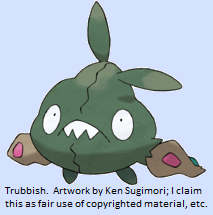
Trubbish and Garbodor

No.
No.
These are not Pokémon and I refuse to let them be called Pokémon.
No.
What, you’re going to argue with me?


Okay, look.  Game Freak.  I’m being reasonable here.  I let you have Liepard, I let you have Stoutland, I let you have Woobat, I let you have Swadloon, I let you have Pignite and I let you have Archeops, but this is where I draw the line!  Ladies and gentlemen, meet Trubbish and Garbodor, the trash bag Po-
 
*ahem*

Pok- P- Poké- Poka-

Porcupines.

You heard me.

Trubbish and Garbodor are, both figuratively and literally, piles of garbage brought to life by an unholy alchemy taking place in some of the most noxious, stifling refuse pits on Earth (I refer, of course, to the offices of Game Freak’s creature design department).  The Pokédex explains that they live in polluted areas, assimilating rubbish into their bodies, and that they fight with a charming variety of horrid toxins, presumably extracted from said rubbish (however, it also mistakenly refers to them as Pokémon, so I’m not sure we can necessarily take it at its word this time).  I have tried – no, honestly, I have – to find some way in which these P- P- *ahem* potatoes are conceptually distinct from Grimer and Muk, and I have failed.   Both are effectively the personification of environmental pollution caused by the industrialisation and increased urbanisation of human settlements, and both were created from the waste products of said urbanisation by a vaguely-defined pseudoscientific phenomenon: in Trubbish’s case, an unspecified chemical reaction between garden-variety trash and industrial waste, in Grimer’s, the reaction of toxic sludge to (and I quote) “X-rays from the moon.”  Both of them are also ridiculously toxic and could probably drop an Indian elephant at fifty paces just by standing upwind.  The only difference I can pick out is that Garbodor looks unbelievably stupid.  Trubbish... eh... considering that the concept they had to work with was “ambulatory garbage bag” I think it’s quite an achievement that Trubbish is as tolerable as he is, but Garbodor is like a master’s thesis in idiocy; he may well be more stupid-looking than any Pokémon I’ve ever seen.
What?
Yes, excluding that one, obviously.
Oh, all right, and that one.
Well, of course he’s not as bad as that one; that bloody well goes without saying, doesn’t it?
The point is, Garbodor is definitely in the top ten – or would be if he were a Pokémon, which he’s not.  That gormless expression, the arms held together by bits of pipe, the puffy ear-tuft-things atop what he so pretentiously calls his head, the trailing strips of green plastic draped over him like a cape, the indefinable blue and pink lumps that festoon his body... nothing about this P- this polyhedron makes me want to let him continue to suffer the pain of his misshapen existence, let alone actually make him my partner.  I don’t know that he’s even properly repulsive; I’m not completely sure that the art style of Pokémon allows for that.  He just looks dumb.

I’m not normally one to use a Pokémon whose flavour I truly despise, even if I’m happy to concede it has potential merit in some role or other.  I readily admit, for instance, that although personally I can’t stand Weezing (Koffing I don’t mind; Koffing I like, but Weezing I hate) he’s undeniably an effective and unusual physical wall.  I say this in order to defend my integrity as I come to talk about Garbodor’s powers and abilities, so that my readers know I went into this with an open mind, fully intending to find a use for him if one existed.  The fact that I failed is as much his fault as mine.  Garbodor truly is dreadful.  I think I’ve mentioned in the past that one thing I like about Black and White is that few, if any, of the new Pokémon from these games are actually unusable, but Garbodor is pretty bad.  His stats are average, his movepool is utter drivel, his type is unremarkable and his abilities are, at best, situational.  Did I miss anything?  No, I think that covers it.  Poison is probably the worst offensive type in the game, being strong against only one other type – Grass – but not bad defensively, with only two weaknesses (Ground and Psychic) and four resistances.  Still, there’s something of a trend that the most effective Poison Pokémon are generally those that have managed to rid themselves of that weakness to Ground attacks somehow, like Weezing, Gengar and Crobat, because it really does hurt.  That’s not Garbodor’s biggest problem, though; his biggest problem is that his slate of useful attacks is extraordinarily limited.  He has some good special attacks, like Thunderbolt and Psychic, but that doesn’t help because he’s no good at using special attacks.  I’m pretty sure the only physical attacks he has that are worth using are Body Slam (which is good because it causes paralysis, and is therefore largely incompatible with Garbodor’s general desire to spread poison), Payback (which is best on a very slow Pokémon, and Garbodor’s not far below average in that department), Gunk Shot (which only hits 70% of the time and is therefore of dubious value) and Explosion (which has certain obvious issues as a go-to move).  Garbodor’s biggest strength is his physical attack stat and he doesn’t even have a reliable physical attack of his own element!  Was Poison Jab really too much?  Would that have sent him over the edge and made him hopelessly overpowered?  Seriously?

...okay.   Accentuate the positive.  I can do this.  Garbodor can learn Spikes (opponents that can’t fly take damage when switching in) and Toxic Spikes (opponents that can’t fly are poisoned when switching in), and given a few turns to set those up he has the potential to make switching in and out of battle hell for an opponent who doesn’t have a Pokémon with Rapid Spin handy to blow away the layer of junk Garbodor scatters wherever he goes.  What’s more, one of his passive abilities, Weak Armour, might actually have a use here – whenever a Garbodor with Weak Armour takes damage, his defence weakens, but he gets faster, and if that makes him faster than his opponent, it will give him time to toss down an extra layer of Spikes or Toxic Spikes before being killed, or just to blow himself the hell up and take his foe with him (his other ability options, Stench and Aftermath, are fairly silly, but reasonable alternatives if you don’t want him taking more damage from every successive attack).  Unlike many Pokémon with Spikes and Toxic Spikes, Garbodor actually has a little bit of bulk to him (he’s no Forretress, but this is all he’s got, so work with him here) so he might be able to pull this off reasonably well.  Heaven knows what else you’d use him for; he’s one of the least effective P- Pok- pomegranates I’ve seen since starting this mad endeavour.
What, you want a conclusion?  No, go away; I’ve been through enough on this idiot’s account.

I hereby deny this Po- Poké- P-
...
Oh, to Hades with it!  From garbage they were born; to garbage let them return!

Saturday, 6 August 2011

Sandile, Krokorok and Krookodile

I could go either way on this one, really.  Let’s see.

Today I’ll be talking about the desert crocodile Pokémon, Sandile, Krokorok and Krookodile.  They are... well... crocodiles that live in the desert.  That’s a good start, but it does seem to me like the designers have been reusing a formula again – and I’m not talking about the older crocodile Pokémon, Totodile, Croconaw and Feraligatr.  What Game Freak have done is take a North African river animal, shift it a few hundred kilometres west, turn it into a Ground-type with a wave of their magic wand and said “eh; good enough.”  Sound familiar?

(This is the point at which I remember that this blog is supposed to be readable for people who stopped playing Pokémon years ago)

It’s exactly what they did when they made Hippopotas and Hippowdon, the desert hippos from Diamond and Pearl.  These Pokémon are basically hippos with sand powers, and there’s really not much more to it than that.  Besides their sand powers, the things about them that the Pokédex feels are most worth mentioning are that they can close their nostrils when submerged and that Hippowdon can bite a car in half.  Real hippos can do both of those things.  I don’t care that a hippo Pokémon can do things that real hippos can do; I really don’t.  Sandile, thankfully, is not so horribly bland.  The main point the Pokédex makes about these Pokémon, surprisingly, is that they have very highly-adapted eyes.  A membrane of dark but transparent skin shields their eyes from the glare of the desert sun like a pair of sunglasses; from at least the Krokorok stage onwards they can see into the infrared, allowing them to detect body heat, and Krookodile can adjust the focus of his eyes over an incredible range, allowing him to view distant objects – and prey – with ease.  Given the emphasis on vision it actually makes a lot of sense that they’d become bipedal but I have to ask myself at this point whether Game Freak actually thought that through or just got it right by sheer dumb luck.  I’m plumping for dumb luck.  Cynical, I know.  The main function of the dark membrane I mentioned earlier, in terms of design, is actually to look like a bandit’s mask as part of the outward expression of Krookodile’s secondary element, Dark.  Their stripes likewise recall the black-and-white striped clothing typically associated with convicts.  The stripes and the mask-shape are nice ways of representing the Dark type, I suppose, and they’re not blatant, which is good because if they were too obvious the whole thing would quickly become cheesy.  I’m not really sure what’s holding this design together, though.  It has some good elements, but the combination seems haphazard; it’s just not there yet.

As I think I mentioned, Sandile, Krokorok and Krookodile are Ground/Dark dual-types.  Ground/Dark is actually a reasonably solid typing offensively and not terrible defensively either – Water, Ice and Fighting weaknesses all hurt, but the immunities to Electric and Psychic attacks are useful enough to redeem it.  Being a Ground-type also comes practically pre-packaged with a strong combination of attacks – Earthquake and Stone Edge – and this is what Krookodile cares about because he’s definitely focussed on offense.  His physical attacks are very powerful, though not quite eyebrow-raising, and he’s not slow either (though he wishes he were faster, and can’t make it happen).  Bulk Up could be fun to push his physical strength through the roof while also shoring up his defences, and might form the basis for a fairly solid moveset.  He’s also got a choice of two lovely abilities for an offensive Pokémon: Intimidate weakens the physical attacks of whatever’s facing you when you send him out, allowing him to switch in on physically-inclined Pokémon with some degree of impunity, and Moxie gives his own physical attacks a little boost every time he kills something, allowing him to start building momentum.  Unfortunately Moxie is really all he has to make himself unique as a sweeper, and he’s not quite fast enough for it to work as well as one might hope, so Krookodile’s other options deserve a look.  As a Dark-type he’s likely to have some skill in fighting dirty, so let’s see.  Taunt is always a viable option on a fast Pokémon with halfway-decent defences; this technique enrages its target and prevents it from concentrating on defence and support techniques, forcing it to attack you directly – which, for a lot of defensive Pokémon, is a decidedly poor course of action.  If you’re prepared to crossbreed, there are a number of lineages that will get Pursuit into Sandile; this is a normally weak Dark-type attack which, when used on a target attempting to switch out, will actually outrun the switch and do double damage into the bargain.  It’s generally regarded as one of the more useful features of Dark-types in general, and between Intimidate, Taunt and fear of his Earthquake attack I’d be inclined to think Krookodile could cause a fair few switches if used at the right moment, so Pursuit might be worth a look.  Probably the most interesting thing Krookodile can use is Foul Play, a powerful new Dark-type attack that relatively few Pokémon can learn.  Foul Play is interesting because, while most attacks use the user’s attack stat to determine damage done, Foul Play uses the target’s attack stat, effectively turning the other Pokémon’s own strength against it.  As fascinating as it is, I don’t know why you’d want to use it on Krookodile since he actually has a good attack stat of his own to work with, probably a better one than the majority of his potential targets.  As far as I can see these are the main kinds of trickery open to Krookodile; they’re fairly standard for Dark-types and I don’t know that he’s particularly good at them, but he’s certainly not bad either if you need a solid Dark Pokémon.

I don’t think Sandile, Krokorok and Krookodile are bad Pokémon, as such, but I think they needed more work.  As regards their in-game competence I actually believe they’re at a pretty good level balance-wise; they’re not so strong that it becomes hard to think of reasons not to use them, but there’s definitely enough there to work with and get good results.  The design really is kind of flat, though.  It’s not terrible, but it’s not cohesive or particularly interesting, and worst of all the basic idea isn’t even new; it’s essentially the same template that was used to make Hippowdon.  Am I being mean again if I get rid of the crocodiles?  Probably, yeah, but damnit, I’ve been training Pokémon for more than ten bloody years now and I’m extraordinarily jaded and irritable.  I can be mean if I feel like it.

I hereby deny this Pokémon's right to exist!  Let it find new purpose in life as a pair of expensive shoes and a fancy handbag!

Wednesday, 3 August 2011

Litwick, Lampent and Chandelure

Today we look at three pretty cute-looking and generally appealing Pokémon... who will suck out your soul.

No, I’m serious, that’s actually what the Pokédex says.

Meet Litwick, Lampent and Chandelure, the candle Pokémon.  These guys are Ghost/Fire-types: another new combination, which is practically a guarantee that what we’re going to get will at least be interesting even if it’s not strong.  The fact that they’re Ghost Pokémon is also, oddly, a good omen in itself because Ghost Pokémon are inherently fascinating; I for one am still trying to figure out what exactly they are.  In the Pokémon world, Ghost-types are generally feared and seen as malevolent spirits, but in many cases this is actually unjustified – Gastly, Haunter and Gengar, famously, are not actually evil but have a very disturbing sense of humour that can easily cause playfulness to be misinterpreted as aggression; Sableye’s predicament is similar.  Some, notably Mismagius, Dusknoir and Drifblim, have mysterious powers that could be used for good or evil, and where they fall on that axis is extremely ambiguous.  It’s also unclear whether these Pokémon are actually spirits of the dead or simply have an affinity for death, the dead, and places of spiritual power – many Ghost-types are associated with spirits in legends, but only a few are unequivocally spirits themselves (and even that’s only if we assume the Pokédex is a reliable source, which is another debate entirely): Shuppet and Banette, who are the possessed remains of abandoned toys, Spiritomb, who is literally made of the imprisoned souls of 108 unrepentant criminals, and Yamask and Cofagrigus, who... well, I’ll have plenty of time to talk about Yamask and Cofagrigus in their entry.  Rotom is so weird I wouldn’t know where to begin.  The point is that, for the most part, we don’t really know what these Pokémon are, where their powers come from, or what they’re up to, but damned if I don’t want to know.  It’d be nice to have the opportunity to investigate, actually – but that’s a discussion for another time; I’m supposed to be talking about Litwick... and, well, he may be cute as a button but I think this one just might be unambiguously evil...

Litwick looks to me to be drawing inspiration from tales of will o’ the wisps (or whatever the Japanese equivalent is), ghostly lights that trick travellers into following them through treacherous swamps to their doom.  Litwick, likewise, pretends to lead people through the darkness, but following him will allow him to siphon away your life force, which he burns as fuel.  Follow him too far and he’ll eventually lead you into the spirit world, and then heaven knows what you’re in for.  Lampent have a slightly different way of working; they occasionally lead groups of Litwick but most often they simply wander around searching for the dead or dying and stealing away their spirits.  There’s no information on how Chandelure behave in the wild, presumably because wild Chandelure would be so absurdly uncommon as to be nonexistent for all intents and purposes, but like his younger forms Chandelure absorbs souls and burns them as fuel.  Lampent and Chandelure both look a little eerie, maybe even sinister, but they’re not the type to have you instinctively run screaming – it would rather defeat the purpose if they were, so I think they’re pretty well-done in that regard.  Once you know what they’re capable of, though, the mental image of Chandelure gesturing languidly with his mesmerizing flames to draw a person closer and closer is... a little worrying.  Remind me, when did this setting get so dark?

Oh yeah, back in Red and Blue when Team Rocket murdered Cubone’s mother.

What I’m getting at is that I think Litwick, Lampent and Chandelure are good additions to the ranks of Ghost Pokémon; I think they’re the only unambiguously malevolent ones besides Shuppet and Banette, whom I don’t actually like very much... maybe it’s just that the story of an abandoned doll seeking revenge sounds so much like B-movie horror to me in comparison to the folktale influences in Litwick’s design.  Between the two, it’s the death’s-candles that leave me wanting to learn more about them, so personally I definitely think they have more of a right to live (or... unlive... or whatever) than the undead dolls.

What’s that?

What do they do?  As in, in a fight?

Oh, well, they blow stuff up.

It seems a bit odd that a Pokémon like this should be a glass cannon; the will o’ the wisp concept seems to lend itself to a Pokémon with a support role, but then again Chandelure’s fire attacks explicitly burn away the soul and leave the body behind, so I guess it makes sense that he should have a ridiculous special attack stat – and I really do mean ridiculous.  Seven Pokémon have stronger special attacks than Chandelure.  All of them are high-tier legendary Pokémon and as many as five of them may well be actual divine beings.  Moreover, Chandelure is neither particularly slow nor particularly frail; he’s too slow to think about sweeping any time soon but, much like Darmanitan, his very presence should make most level-headed opponents think very cautiously about their next couple of moves.  His offensive movepool’s not brilliant but it’s good enough – a decent Ghost attack in Shadow Ball, a choice of several powerful Fire attacks, and Energy Ball and Psychic to round things out.  You could, if you were so inclined, slap Flame Charge on him – Chandelure’s a rubbish physical attacker but if you get a free turn to use it (entirely likely since just seeing him would likely provoke many opponents to switch out) its side-effect – increasing the user’s speed – might just make him fast enough to pull off a sweep after all.  Alternatively, Chandelure can even learn Calm Mind to boost his special attack even further, just in case you feel he’s not powerful enough already.  The last of Chandelure’s options I want to touch on is one that would work well with Calm Mind, but I’m not sure how I feel about it.  Chandelure’s Dream World ability is Shadow Tag, which utterly forbids his opponent from switching out from the moment he arrives on the battlefield.  The reason I’m not sure about it is that it’s a total game-changer; Pokémon is to a great extent all about continually switching to try and put yourself in an advantageous position.  If Chandelure can safely switch into something that he knows he can beat... well, that Pokémon’s almost certainly dead, with little hope of rescue.  To illustrate how much of a game changer Shadow Tag is, the last Pokémon Game Freak gave it to – Wobuffet – was depressingly bad in Gold and Silver, before abilities were introduced, but has since been banned in many circles because taking out at least one Pokémon is normally trivial for him, no matter what he's up against.  In Wobuffet’s case it’s really a combination of powers that leads to that conclusion, one Chandelure doesn’t have, but I still have something of a knee-jerk reaction against giving Shadow Tag to anything that’s actually competent without it.  Still, for now it’s something of a moot point since Dream World Litwick aren’t available yet anyway – and one of Chandelure’s regular abilities, Flash Fire (which absorbs incoming Fire attacks to strengthen his own), is a solid choice regardless.

For a sweeper Chandelure is worryingly slow and has only a decent movepool... but he’s still horribly strong, there are other roles he can fill (like clearing the way for a different sweeper) and let’s face it, I like his flavour so much that he would have had to be pretty bad for me to toss him anyway (Zebstrika, I'm looking at you).  Vague balance concerns about Shadow Tag aside, I think this is, all around, an excellent piece of work.

I hereby affirm this Pokémon’s right to exist!